2025
Interiors Source
A B2B trade marketplace taken from a broad, ambiguous vision to a clear, buildable MVP in two weeks, using an AI-first discovery workflow.
I led discovery and product definition for Interiors Source, a marketplace built to unify the fragmented workflows of interior-design trade professionals, suppliers, and clients. Using AI as an operating layer for research, synthesis, and prototyping, I compressed 0→1 discovery and aligned the client and team around a sharp, defensible MVP scope.
Role
Product lead, discovery
Timeline
2 weeks, concept → MVP
Approach
AI-first workflow
The Challenge
A trade industry that ran on relationships, not systems
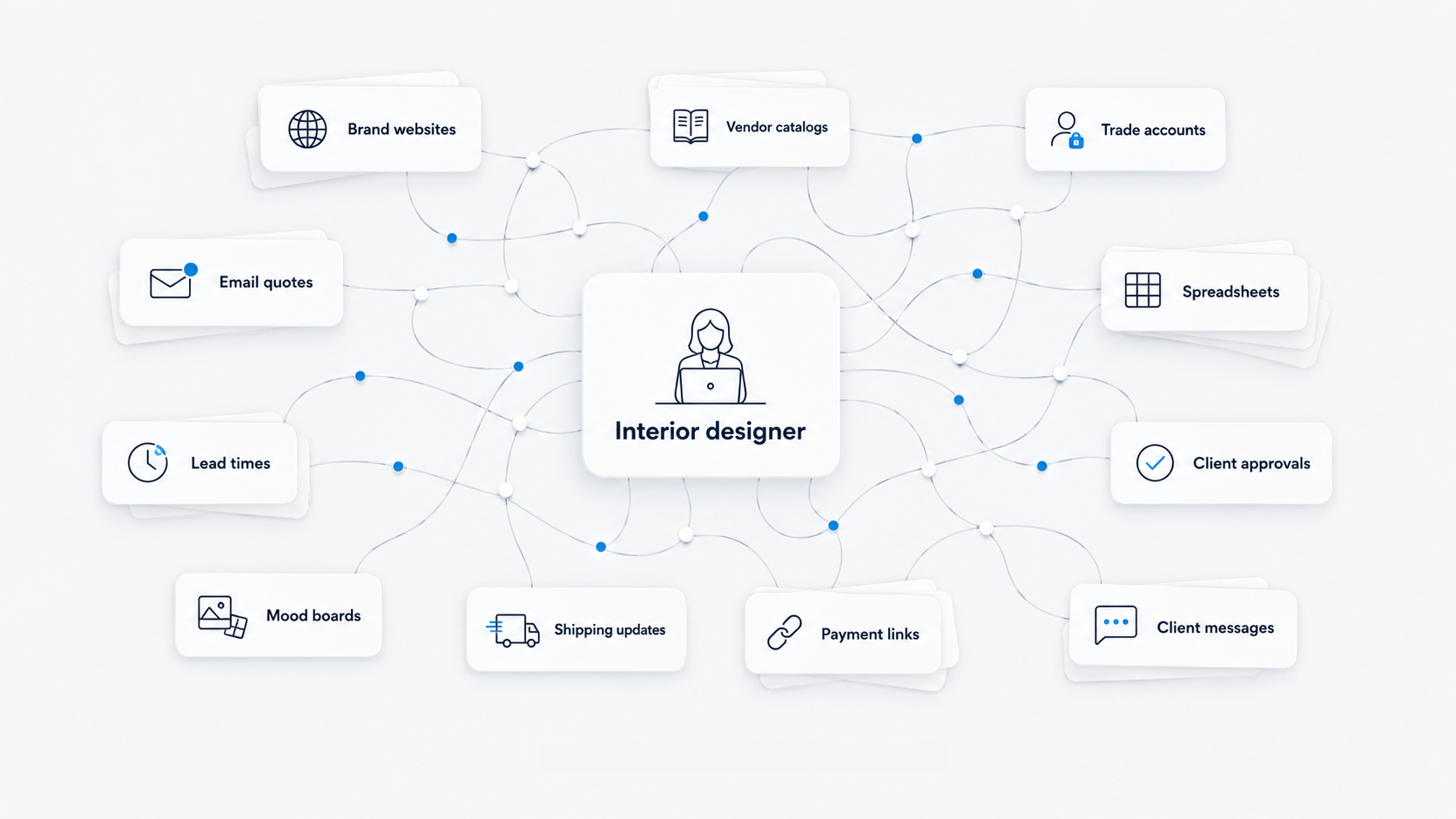
Interiors Source set out to build a B2B trade marketplace for the interior-design industry: one platform to reduce the fragmentation across a wide cast of actors. That cast included interior designers as the primary user, plus their end clients, vendors and manufacturers, general contractors and developers, retailers, and the internal team running operations.
The opportunity wasn’t simply to “put products online.” The real challenge was understanding how the pieces of the trade journey could come together in one seamless flow: discovery, pricing visibility, trade access, quoting, wishlists, project management, purchasing, payments, order tracking, and logistics.
This was a space where work happened through supplier relationships, scattered catalogs, email threads, and phone calls. It was manual, offline, and rarely connected through technology.
Bring clarity to the ambiguity: understand the market, map the trade journey, define the business model, align stakeholders, and translate a broad vision into a buildable MVP.
Approach
One PM, one connected workflow
The usual 0→1 model splits the work across people and weeks: a PM runs discovery and research, hands findings to a designer, waits for a prototype, and pays for every revision in days. On Interiors Source, it was a single connected loop. I ran the interviews, the research, and the prototyping myself, with AI as the connective tissue between them.
Instead of a stack of documents, the whole vision became something we could see, which made the scope calls (ship now, simplify, defer) far sharper.
The AI workflow
How the pieces connected
01
AI notetakers
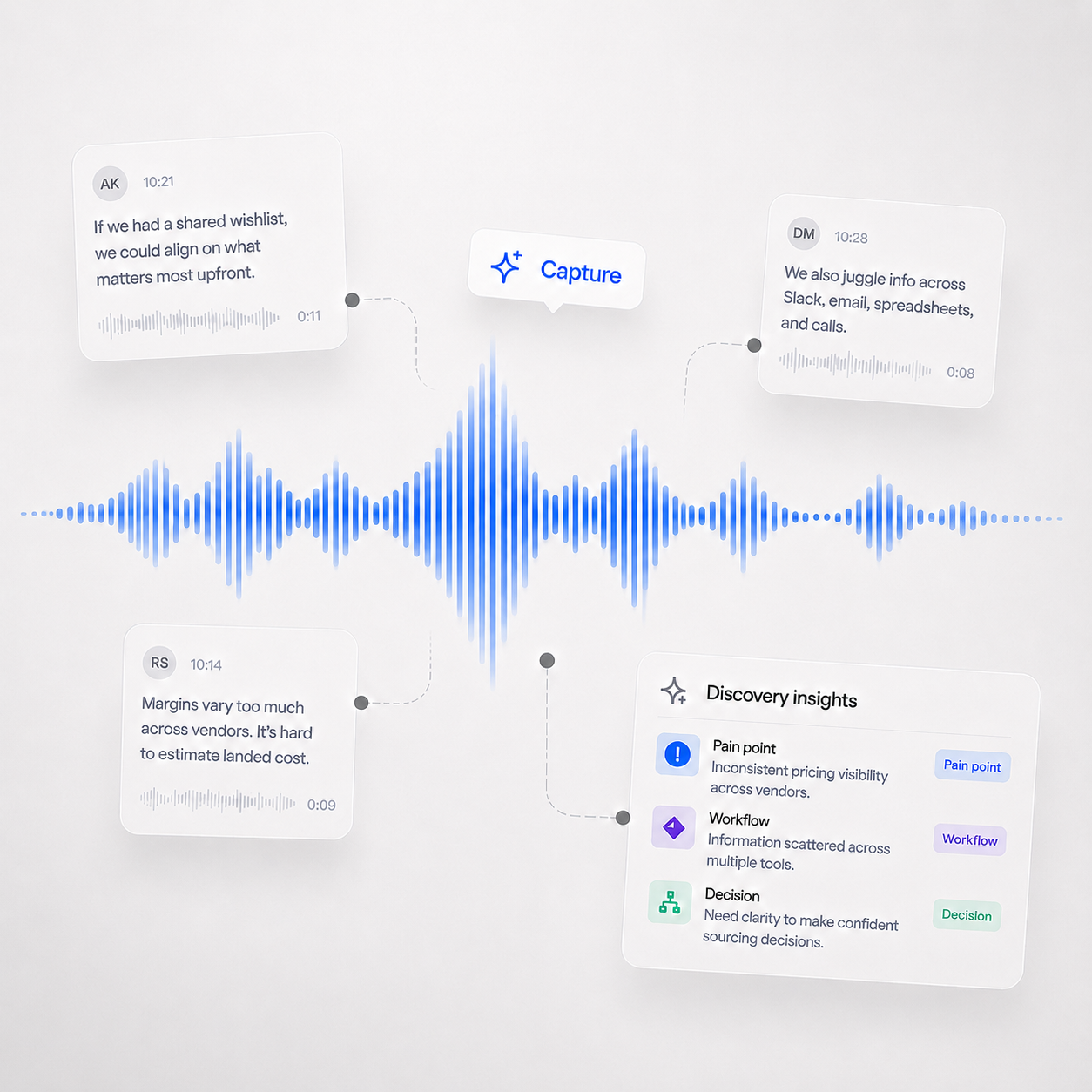
Captured every discovery session accurately, so I could drive the conversation instead of scribbling notes.
02
Consistent context
Fed those transcripts into LLMs to synthesize inputs and keep decisions structured and consistent.
03
Grounded research
That shared context sharpened market and tooling research across the trade workflow.
04
Tailored prototypes
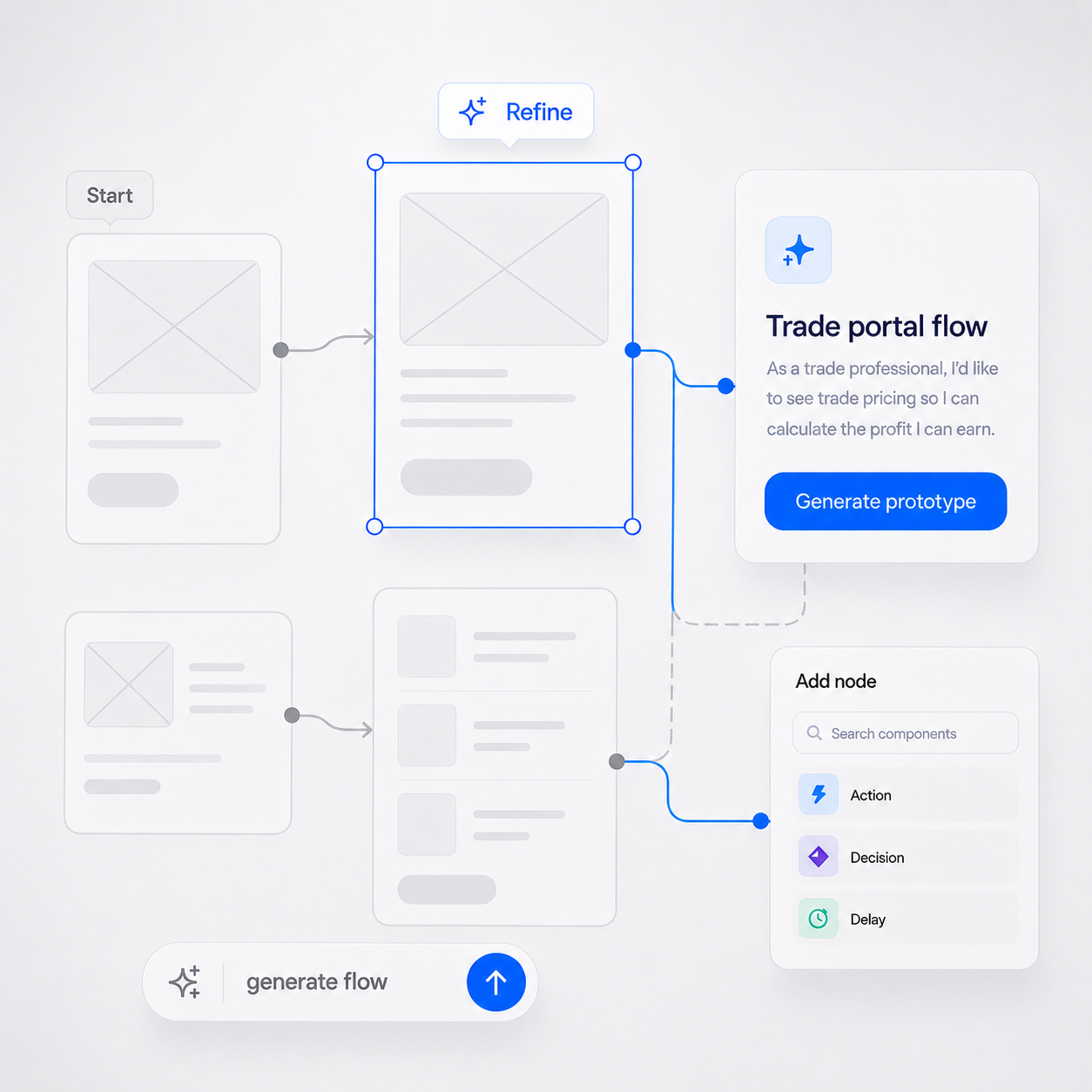
Flows built fast and cheap, using industry-standard patterns shaped to the Interiors Source vision.
How it unfolded
Five discovery sessions, then into the build
Sessions 1–2
Users & use cases
Mapped every actor in the trade: designers as the primary user, plus end clients, vendors, GCs and developers, retailers, and admins. Captured their pain points, how they get work done today, and what the ideal solution looks like.
Session 3
Market & tooling landscape
What solutions already exist, and the tools trade pros stitch together for sourcing, communication, quoting, and project management.
Start of ideation
AI prototyping begins
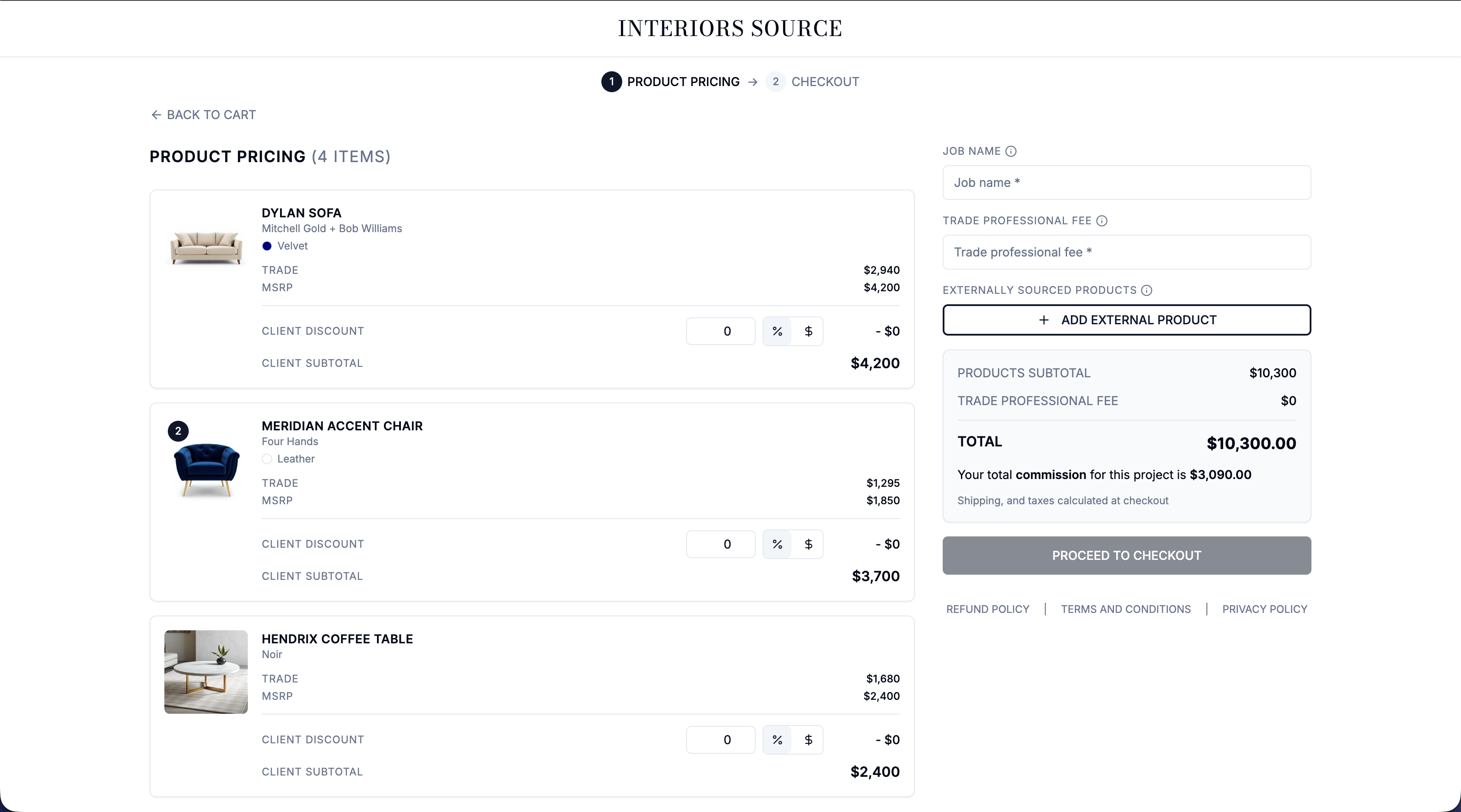
Started building the first flows straight out of discovery, covering catalog, pricing, and quoting, all tailored to Interiors Source and ready to react to.
Session 4
Launch priorities & early validation
What’s essential for launch, how monetization works, and the gaps still open, alongside early validation on the first prototype flows.
Session 5
Business model & validation
Quoting, commissions, the business model, and project management, all reviewed against the live prototype rather than a deck.
Next
Into MVP development
The prototype and discovery report carried straight into the build as a living reference for engineering and design.
Because prototyping ran alongside the last two sessions, we reviewed working flows instead of slideware, and tested assumptions in days, not weeks.
What made it complex
Several product models, fused into one platform
01
Many products in one
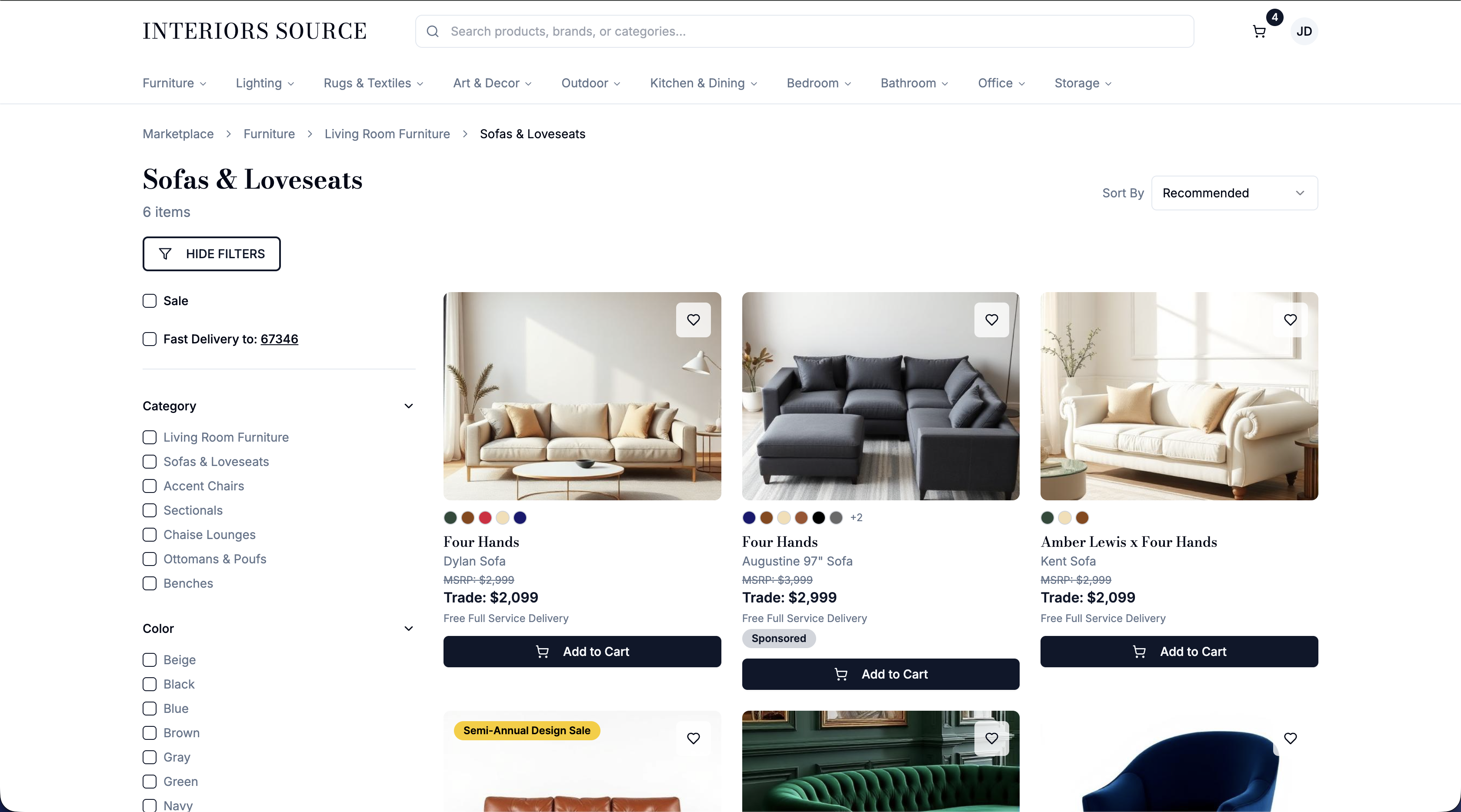
Interiors Source was part marketplace, part trade portal, part workflow tool, and eventually part project-management system. Each model carried its own logic, and they all had to coexist.
02
Different needs per user
Trade professionals, end clients, suppliers, and internal admins couldn’t all see or do the same things. Role-based permissions and expectations shaped nearly every flow.
03
Pricing vs product
Trade tiers, pricing visibility, commissions, and purchase flows affected the product experience so business model alignment and MVP scoping had to happen together.
The biggest product challenge was avoiding an overloaded MVP. When the vision is broad, every feature feels important, but the AI-assisted prototypes made the trade-offs tangible enough to actually make.
So, one question shaped the MVP
Would interior designers actually adopt a centralized sourcing marketplace in their day-to-day workflow?
The core value proposition was clear: give designers one place to browse products across brands and vendors, access trade pricing, save selections, share them with clients, and complete purchases on-platform. So the MVP was deliberately kept focused on the smallest experience needed to test that behavior.
Anything that was not required to prove adoption was kept manual or deferred. Vendor onboarding and order status updates could be handled by the Interiors Source team in the early stage, giving the business a real workflow without overbuilding automation too soon.
Larger product bets like project management, trade professional profiles, community features, advanced vendor logistics, and AI renderings stayed on the roadmap for later phases.
Outcome
A foundation the team could build on
Interiors Source moved from a broad product concept to a clear, buildable MVP scope in two weeks. The process aligned the client and internal team around the core marketplace experience, while cleanly separating the immediate MVP from future capabilities.
The result was a product foundation that gave design and engineering enough clarity to move into execution without losing sight of the larger vision.
2 weeks
From kickoff to a locked MVP scope
Discovery, synthesis, prototyping, and stakeholder alignment accelerated through an AI-assisted workflow.
What I took away
AI can meaningfully change early-stage product work. Not by replacing product judgment, but by helping a PM explore more options, synthesize faster, align stakeholders earlier, and make sharper scope decisions under ambiguity.